Table of Contents
I still remember the exact moment this cut went from “yeah, that’s clean” to “holy hell, everyone has it.” It was late 2022, some random Tuesday night in East London. I was waiting outside a barbershop that doesn’t even have a sign anymore, just a neon scissor in the window, and this kid walked past me. Maybe twenty-one, wearing an oversized charcoal hoodie, black jeans, white Air Force 1s that had seen better days. Nothing special about the fit, honestly. But his hair stopped me dead.
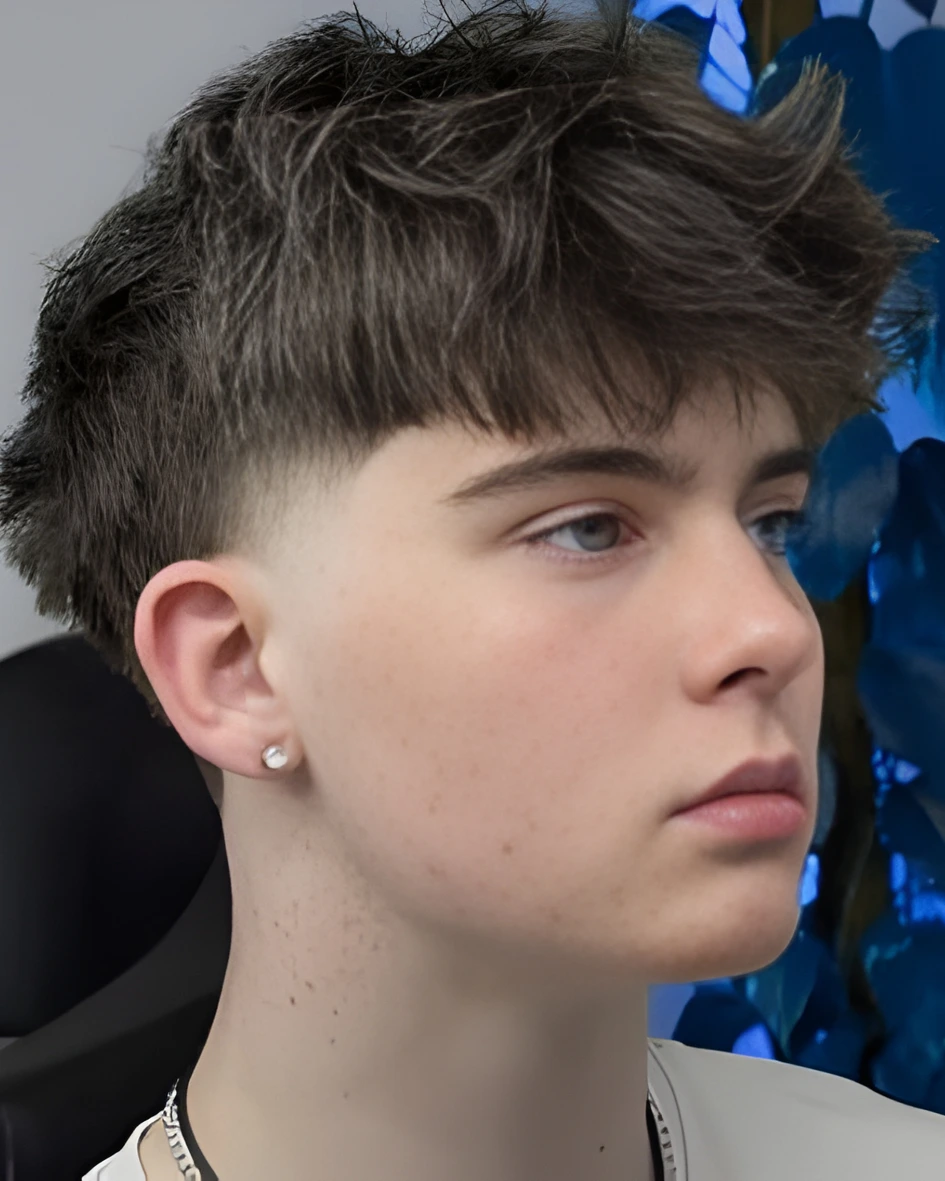
The top was straight, thick, somewhere between brown and dark blond, falling in this careless, almost annoyed way over his forehead and ears barely visible, pieces sticking out at weird angles like he’d been wearing a beanie and ripped it off five hours ago. The sides weren’t skinned. They weren’t even mid-fade tight. They just melted, softly, gradually, into almost nothing around the ears and neck. A low taper so subtle you only noticed it when the streetlight hit from the side. The whole thing looked like he’d cut it himself at 3 a.m. with kitchen scissors and somehow won the lottery.
I watched three separate people do a double-take as he walked past. Not girls, not guys trying to check his shoes, just regular people on their phones who suddenly forgot what they were doing. That’s when I knew something had shifted.
Fast-forward three months and my chair was full of screenshots. Not mood boards with Timothée Chalamac or Brad Pitt in Fight Club (the usual suspects). These were blurry photos of random dudes on TikTok, Instagram Reels: Korean guys on the subway, footballers warming up before Champions League games, even that one quiet guy from accounting who suddenly looked like he could model for Acne Studios on weekends. Every single picture had the same DNA: straight hair, decent length on top, messy like it was allergic to combs, and a taper that started so low it almost felt accidental.
The skin fade boys were mad. The curly high-top crowd rolled their eyes. Barbers who spent years perfecting hard parts and surgical lines quietly started sweeping the floor more because clients kept saying the same four words: “Just make it messy.”
Thing is, nobody called it “messy low taper straight hair” back then. We didn’t have a name for it. Clients would just shove their phone in my face and say “this, but don’t make it look like you tried.” That was the whole brief. The highest compliment you could get walking out the shop was someone asking “who’s your barber?” and then immediately adding “actually, never mind, it looks like you don’t even have one.”
By summer 2023 the wave was undeniable. You couldn’t scroll for ten seconds without seeing it. Japanese street-style accounts, Brazilian footballers, even finance bros in Singapore trying to look less like their LinkedIn picture. The cut crossed every border, every tax bracket, every hair type (though straight hair wore it best, and we’ll get to why in a minute). Instagram explore pages turned into a cult. Hashtags didn’t even matter anymore because the algorithm knew: if the top was shaggy and the sides disappeared without drama, you served it to every guy with a pulse.
And the wildest part? Nobody famous started it. There was no celebrity co-sign, no viral red-carpet moment. It just… happened. Like one day the entire male population woke up, looked at their strict skin fades and perfect blowouts, and collectively said “yeah, I’m tired.” Tired of looking like they spent forty-five minutes with a round brush and three pumps of volumizing mousse. Tired of barbers drawing lines sharp enough to cut glass. Tired of hair that looked amazing for exactly six hours and then collapsed into sadness the second humidity or a hat got involved.
The messy low taper straight hair didn’t ask for any of that effort. It looked better when you ignored it. It looked expensive when you slept on it wrong. It turned pillow creases into texture and helmet hair into a flex. For the first time in years, maybe ever, guys wanted to look like they didn’t care, and the universe rewarded them by making them look like they cared exactly the right amount.
That random kid outside the barbershop that night? Never saw him again. But I swear every third client who sits in my chair now is chasing the ghost. They don’t know his name either. They just know how he made them feel: like cool was something you could stumble into by accident. That’s when I knew the cut wasn’t a trend. It was a quiet revolution with terrible posture and amazing hair.
Why Straight Hair Actually Loves This Cut More Than Curly or Wavy
Curly and wavy guys can wear a messy low taper, sure. I’ve cut plenty and they look solid. But straight hair? Straight hair doesn’t just wear it, it speaks the language fluently.
Straight strands have no natural curl pattern to fight for attention. That means every bit of movement you see up top has to come from the cut and how you mess with it. When the top is left three to five inches and the weight is distributed evenly, those straight pieces fall exactly where gravity tells them to, never in the same spot twice. One day it flops left, next day it splits in the middle like it’s having an identity crisis. That randomness is the entire trick. Curly hair already has personality baked in; straight hair has to earn it, and this cut hands it the cheat code.
Weight is the other secret. Straight hair is usually denser and heavier than curly. When you keep real length on top and only whisper the sides away with a low taper, the top literally pulls itself forward and down. No pomade mountain required. No round-brushing at 7 a.m. while you curse your reflection. The hair does the work. I’ve watched guys walk out my shop, shake their head once like a wet dog, and instantly look like they paid someone in Soho two hundred quid for texture.
Then there’s the way straight hair catches light. Curly hair scatters it, wavy hair bounces it, straight hair slices it into those clean, glassy lines that make the mess look expensive instead of homeless. Streetlights, office fluorescents, golden hour, doesn’t matter, straight strands turn into little mirrors that say “yes, I woke up like this, no big deal.”
And the biggest flex: straight hair forgives laziness. Miss a wash day? Looks better. Sleep on it weird? Now it has character. Run your hands through it on the Tube because you’re late? Congratulations, you just styled it. Curly hair punishes neglect; straight hair turns it into a feature. Bottom line: if your hair grows down instead of out, the messy low taper was built for you. Everyone else is just renting the vibe.
Getting the Cut Right the First Time (So You Never Have to Fix It Later)
Here’s the script that gets you the perfect messy low taper straight hair 99 % of the time, even if your barber speaks broken English or thinks he’s Picasso with clippers.
Walk in, pull up three photos (front, side, three-quarter, and back) of real guys with the exact vibe, not celebrities. Then say these words in this order:
“Top left four to five inches, point-cut for texture, no blunt lines, needs to fall forward messy. Sides and back low taper, start the fade an inch above the hairline, blend down to skin with no hard lines, nothing above a 1 guard. Keep the neckline soft and rounded, no square block. Behind the ears tighter than the sideburns so it pulls forward. No part, no skin showing anywhere except the very bottom fade.”
That’s it. The whole thing takes fifteen seconds to say and saves you six weeks of growing out a mistake.
If the barber nods and immediately reaches for the 0 guard or starts talking about “drop fade,” stand up and leave. Seriously. I’ve seen too many guys sit politely while their dream cut turns into a 2021 TikTok skin fade.
One detail most guys forget: ask for the top to be point-cut, not slide-cut or razor-cut. Point-cutting leaves soft, jagged ends that move like real “I just woke up” hair. Blunt or razor ends look too perfect and collapse by day three.
Bonus move: tip well on the first visit and book the next one before you leave. This cut lives on the barber remembering exactly how low and soft you like the taper. Once they have it dialed, it’s autopilot for years.
The Magic Length Zone on Top
If you get the length wrong, the whole messy low taper straight hair fantasy dies in the chair. Too short and you’re stuck with a posh schoolboy side part. Too long and you’re one beanie away from looking like a SoundCloud rapper who still lives with his mum. The goldilocks zone is brutally narrow: three to five inches on top, measured from the front hairline straight up to where your head starts curving back.
Four inches is the cheat code for 90 % of guys. It’s long enough to flop over the forehead, split in the middle on lazy days, or get pushed back with one hand when you’re trying to look serious on a date. Short enough that it never turns into a curtain you have to keep tucking behind your ears like a 2009 Justin Bieber stan.
Three inches works if your hair is thick and heavy; it gives that sharp Korean-idol fringe that falls like a guillotine. Five inches is the maximum before maintenance becomes a war. At five and a half you’ll spend half your life shaking hair out of your eyes or reaching for clips, and the taper starts looking like an afterthought instead of the main character.
Pro tip: when your barber asks “how much off the top,” never say “just a trim.” Say “take whatever keeps me at four inches in the front.” They’ll measure with their fingers (watch them). If they don’t measure, they’re guessing, and guessing is how you end up with two inches and three months of regret.
Once you live in this length window for two cycles, you’ll notice something weird: your hair starts training itself. The way it falls becomes muscle memory. You’ll wake up and it’s already 85 % there. That’s when you know you’ve cracked the code.
That Barely-There Taper: Low, Gradual, and Invisible
The taper is 70 % of why this cut feels expensive and the other 30 % is the mess on top. Screw it up and the whole thing collapses into “guy who asked for a fade but chickened out.”
A true low taper for messy straight hair starts stupidly low, literally one finger-width above where your hairline naturally ends at the neck and sideburns. Any higher and you drift into mid-fade land, which makes the top look like a toupee sitting on a buzzcut. The fade itself should feel like smoke: you sense it’s there, but you can’t find the edges.
Barbers who get it will open with a 2 or 1.5 guard, drop half a guard every half inch, then switch to lever work and a foil shaver that barely kisses the skin. The final half inch around the ears and neck is feathered so lightly you can still see individual hairs lying flat instead of a hard shadow. From three feet away the sides should look like five o’clock shadow, not a gradient you can screenshot and zoom in on.
Here’s the secret sauce most barbers miss: the back should be tighter than the sides by half a guard. It pulls the whole silhouette forward and stops the head from looking wide and boxy from the front. Sideburns stay a touch longer and softer so the fade feels like it’s melting instead of stopping.
If your barber finishes and you can draw the fade line with your finger, it’s wrong. When it’s right, even you won’t know where the short hair ends. That invisibility is what lets the messy top steal the show without competition.
Day-One Styling When It’s Fresh from the Chair
You just paid for the cut, don’t ruin it with a 20-minute routine. Here’s the lazy genius method that makes you look like you have a private stylist.
Hair still damp from the shop rinse? Perfect, keep it that way. Flip your head forward, rough-dry with a towel like you’re trying to start a fire. Stand up, take a pea-size dab of matte paste (I use Reuzel Matte Clay or Arcadian Matte Paste, both disappear in straight hair. Warm it between your palms until it’s basically nothing, then rake from the nape forward, fingers wide like bear claws. When you hit the front, push everything slightly forward and up, then let gravity do the rest.
One hard shake left, one hard shake right. Done.
If it’s too neat, grab random pieces and twist them outward. Takes eight seconds and adds that “I definitely didn’t plan this” texture. No comb, no brush, no mirror staring. Total time: 90 seconds. Walk out and watch people will swear you spent half an hour.
Want it even more undone? Hit the roots with a pinch of sea-salt spray while damp, scrunch once, then forget about it. The salt gives straight hair grip so it holds the mess all day without feeling crispy.
That’s literally it. Anything more and you’re working against the cut instead of with it.
Turning Pillow Hair into Intentional Mess the Morning After
Best thing about this cut? Day-two hair is usually better than day one.
Wake up looking like you lost a fight with the pillow, perfect, you’re 80 % there. Run your hands under the tap for three seconds, just enough to wake the strands up. Shake off the water like a dog. Now choose your weapon:
- Lazy route: two quick pumps of sea-salt spray, scrunch from the ends upward, flip your head upside down, give it three hard shakes, flip back. Takes 20 seconds.
- Slightly less lazy route: same thing but add a rice-grain of matte paste on your palms first, then scrunch. The paste locks the pieces that want to stick out and turns bed-head into paid-for texture.
Key move: never touch the top again after the flip. Whatever weird cowlick or rogue strand is poking up, leave it. That’s your signature now.
If you slept on one side and it’s completely flat, blast the roots with a hairdryer on cold for ten seconds while pulling upward with your fingers. Cold air sets the shape without adding shine.
By the time you reach the door it should look like you rolled out of someone else’s bed and still managed to look unfairly good. That’s the entire point.
Product Mistakes That Turn “Messy” into “Greasy” Real Quick
Straight hair is a snitch. It shows every drop of oil like a crime-scene spotlight, so most guys ruin the cut in the first week by using the wrong stuff.
Rule one: if it shines, it dies. Pomades, gels, anything with “high hold” or “wet look” in the name, leave them for the slick-back boys. Your enemies are coconut oil, argan oil serums, and that £40 “grooming cream” the influencer gifted you. They turn the messy low taper straight hair into limp ramen by lunchtime.
What actually works: matte products that disappear. My current rotation:
- Light clay (Arcadian, Blumaan Monarch) for thick hair that needs grip.
- Fibre paste (Reuzel Matte, Lockhart’s Light Hold) for finer strands.
- Sea-salt spray (Byrd, Slick Gorilla) as a pre-styler only, never solo on straight hair unless you want straw.
Start with half the amount you think you need. Straight hair multiplies product like gossip. One rice-grain dab, emulsify until your palms are dry, then rake through. If it still feels sticky after ten minutes, you used too much and you’re cooked for the day.
Biggest lie on TikTok: “layer five products for texture.” That works when you have ring light and a film crew. In real daylight you just look like you lost a fight with a deep fryer.
Growing It Out Without Entering the Awkward Stage from Hell
The messy low taper straight hair grows out cleaner than any other cut, but only if you don’t panic at week eight.
Weeks 1–6: pure honeymoon. Keep the taper cleaned every three weeks, let the top run wild. Weeks 7–10: the “helmet” phase threatens. Book a maintenance trim that removes weight inside the top, not length. Tell them “texture only, no inches off the front.” Suddenly it flops again instead of puffing.
Week 12+: you now have enough to switch personalities. Middle part, curtains, or push it all back with a light cream and you’ve got a completely different cut without ever looking awkward. Most guys discover they actually prefer the grown-out version and just keep the taper touched up forever.
Secret weapon: beanies and caps are your best friends months 2–4. Pull the beanie low so only the front fringe sticks out messy, looks intentional, hides the triangle stage at the back. By month five you’re basically wearing a wolf cut without the mullet shame. Zero regrets.
Seasonal Switches Most Guys Never Think About
Same cut, different seasons, completely different vibe if you tweak two tiny things. Summer mode: ask for internal weight removal (thinning shear work inside the top) and take the taper half an inch higher. Hair feels ten times lighter, dries in five minutes after the beach, and the mess looks sun-kissed instead of sweaty. Swap matte paste for salt spray + tiny bit of cream so it moves in the heat.
Winter mode: let the top grow heavier and drop the taper lower again. The extra weight fights beanie flattening and gives that moody, slightly darker texture perfect for coats and scarves. Switch to a stronger clay so the pieces hold when the air is dry and static tries to ruin your life.
One extra trick: in winter, finish with a pin-drop of light oil only on the very ends (literally two drops). Stops the straight strands from looking fried under Christmas lights while keeping roots matte. Two visits a year you change the brief by one sentence each, and nobody can figure out why your hair looks perfect 365 days straight.
FAQs (Frequently Asked Questions)
Works on thin hair?
Yes. 3–3.5 inches + heavy texture + volumizing salt spray.
Barber keeps going mid fade?
Point one inch above your neckline and say “start here.”
How often to the shop?
Taper tidy every 3–4 weeks, full cut every 8–10.
Receding corners?
Mild = OK (messy fringe forward). Heavy recession = switch to crop.
Cheap products that don’t suck?
Slick Gorilla salt spray + Gard matte paste = £17 total.
Big forehead?
This cut hides it. Never push the hair back.
How long until it looks good again after a bad cut?
6–8 weeks max if you keep the taper cleaned.